
By Tshepo Thobejane
I recently conducted site visits with a group of participants who requested to visit companies with good Lean adoptions after attending one of our in-house training programs. One of the site visits reminded me of a story shared by Art Byrne in one of his articles shared on the Lean Global Network’s Plane Lean magazine a couple of years ago. In this article, he was sharing his first experience with the Toyota Production System (TPS) in the 1980’s, before the name Lean and its body of knowledge were captured in print by the Western World.
Art shared the conversation that he had with consultants from a Japanese firm called Shingijutsu Consulting, which was founded by three former Toyota executives who had worked directly for Taiichi Ohno, one of the key figures behind TPS. Shingijutsu consultants were in the US to facilitate a one-week seminar on Just-in-time (one of the early names used to refer to TPS at that time). Art and his colleague managed to build a working relationship with these consultants and to learn from them over a couple of years.
Art tells us that after a short while of working with the Japanese, he and his colleagues realised that TPS was the greatest strategic weapon they had ever seen. One day at lunch they asked the president of Shingijutsu Consulting, Mr Iwata: “Iwata-san, TPS is the greatest strategic weapon we have ever seen. How does Toyota allow you guys to go out and teach it to others?” Art shared: “He just looked at us and laughed. ‘I can tell you about TPS,’ he said, ‘I can even take you and show it to you, but I bet you can’t go home and do it.’” To read the story and article in depth you can find the link below
Readers of Planet Lean will most likely be familiar with the Halfway Group which has numerous articles plus a documentary published on Planet Lean’s YouTube channel. It was specifically the site visit to the Halfway Production Centre (HPC) and how it was designed that reminded me of Art’s article. The group that I was traveling with had the privilege of being hosted by Terry O’Donoghue (Senior Advisor), Hashiem Davids (General Manager), and Nqobile Ntshalintshali (Group Leader) in addition to the Team Leaders and staff at the different workstations.
Our group started by following Hashiem and Nqobile as they went on to join and participate in five Asakai (morning meeting in Japanese) sessions. The first meeting started at 7:00am and the last meeting was completed before 8:00am. The group was then given an overview of some of the visual boards used in the morning meetings and we then followed the process step by step. The final activity for the site visit was a reflection exercise facilitated by Terry, which left me with many Aha-moments and an appreciation of how the principles behind Lean Thinking are so simple and yet easy to miss. The group was asked to respond to two question and to capture their responses on sticky notes. The reflection questions: “What did you see?” and “What do you believe is our purpose?”
This reflection exercise reminded of the article by Art and led me to reflect on the benefits and shortcomings of site visits. Considering all these experiences, I think the key benefit for site visits is to drive motivation to start or continue the new way of managing operations. They provide a firsthand exposure to what is possible and give confidence that this way of managing work works. They can also provide a benchmarking reference for those who are already on the journey looking to learn from advanced organisations. On the other hand, the key challenge is whether people on the site visit will fully grasp the principles and the thinking that underlie what is perceptible.

One of the book titles that I can never get over its profoundness is “Learning to See” by John Shook and Mike Rother. Recognising the need to “learn to see” requires a high level of self-awareness, especially when we are adults. Learning to see is a process that start at birth and is one of the first things that we learn in our development. We are told that newborns start off by seeing in shades of grey, black and white with a vision that is limited to a range of 8 -12 inches which is perfect for looking at a parent’s face. It is said that colour vision starts after one week and fully develops with tracking by 5-6 months. The infant’s eyesight will be well developed by the time they start crawling. All of this relates to the physical aspect of seeing. There is another aspect of seeing, which goes beyond this physical processing of light by our visual system.
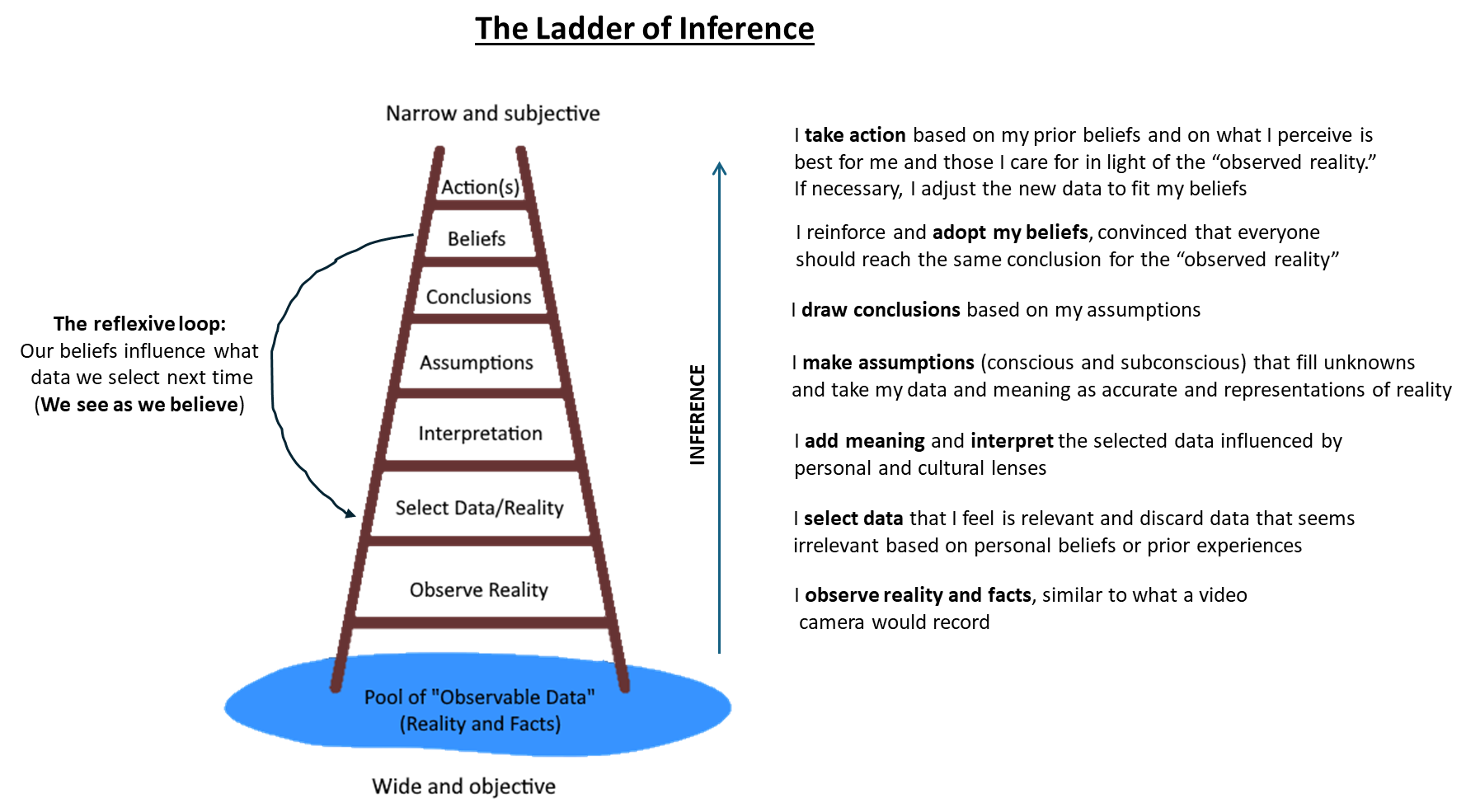
The Ladder of Inference is one of the available models to help us grasp and recognise the cognitive processes that are involved the process of seeing. Through this model we can understand why seeing is not a simple process as it describes the subconscious thinking process people use to move from a factual observation to a final decision or action. Developed by Chris Argyris in 1974, it maps the cognitive processes from observing facts, selecting data, adding meaning, making assumptions, forming beliefs, and finally acting. This model helps to explain why different people can look at the same data and reach different conclusions. This helps to explain the diversity of the responses to the reflection exercise during our site visit. Studying the Ladder of Inference helps to uncover the beliefs and assumptions that render us blind in spite of our visual sight.
The question which the group struggled with was about the purpose of the organisation (not shown in the above image). The purpose statement was posted at several of the workstations that we visited but didn’t catch our attention since our attention was mostly on the visible artefacts. Indeed, the purpose is not easy to grasp through basic observation. What was interesting is that it was only after we were shown the purpose statement that some of our observations became more meaningful.

For example, we spent some time looking at an impressive visual board that is used to track vehicles coming in for repairs. At first impression, the board looks complex for an outsider because it consists of many columns and different coloured pieces. After Nqobile gave us an explanation of the board and its elements, it became clear how to read and use the board. Impressed by both its simplicity and complexity, I asked Nqobile how they came up with the concept of developing and using this board. She explained that they came up with the board in the process of solving the problem of not meeting promised lead time to clients. Terry emphasized that we must recognise that the problem came before the tool was developed. In addition, the current version was the 6th revision of the board. It was also clear in some observations that Hashiem was coaching Nqobile and Terry was also coaching Hashiem and Nqobile in some of the engagements. I can therefore say that, I saw the purpose being lived and actioned during this site visit.
Interestingly, the practice of experimenting to improve flow was shared as one of the key themes in the 2017 Planet Lean article discussing the transformation at the HPC. When Planet Lean visited in 2017, the Production Centre was at version 6.1 of their value stream. Some of these factors will not be easy to pick-up during a site visit unless the host is intentional about the design and communication to visitors on what is being observed. I was stunned to see that HPC has a standard for hosting site visits. This standard is also reviewed and improved based on feedback and past experiences.
Beyond the challenge of knowing what to do after sight visits, I also wondered about the challenge of attending a 3-5 day training on improvement and then returning to your old environment. Lean is a process of learning, and sometimes learning can be a bit messy. A number of stories from experienced TPS practitioners who worked at Toyota indicate that they were assigned a sensei especially when in management roles. If you attended training but your environment does not support the new way of managing and you don’t have an experienced coach to hold your hand: “what are the chances that you will sustain new practices when experiments do not immediately yield desired results?” On the other hand, even if the results are immediately improved, it is still a major challenge to keep the focus and imbed the transformation without coaching support. It would be great to hear how some people successfully navigated this challenge.
Links to articles:
Here is the link to Art Byrne’s article: Planet Lean article
Link to HPC articles:
https://www.planet-lean.com/articles/halfway-production-centre-lean-transformation
https://www.planet-lean.com/articles/halfway-production-centre-apps-lean-it
https://www.planet-lean.com/articles/the-architecture-of-a-lean-transformation
https://www.planet-lean.com/articles/lean-obstacles-halfway
https://www.planet-lean.com/articles/lean-houses-for-dragons-book-review
Link to HPC documentary: https://www.youtube.com/watch?v=TKhwBFuX7ek&list=PPSV
